
Traffic
Looks fine, breaks under real traffic
AI often writes code that works with tiny data and light usage, but slows down badly when real users, large tables, filters, exports, or repeated requests hit it.
The Operating System for Serious Vibecoding
Code faster. Review deeper. Secure harder. Ship with real proof.
Five downloadable markdown (.md) constitutions that force Codex, Claude, Cursor, Windsurf, and similar AI tools to think more carefully before they write, review, secure, QA-check, or sign off on serious software.
Instant digital download · 5 markdown files · single files or full bundle

Compatibility
Use these constitutions inside your current workflow — no plugin, no extension, no platform lock-in.











The 5-Layer System
These are not five random prompt files. They are five constitutions designed to govern different stages of AI-assisted software work — from writing code to reviewing risk, securing behavior, QA-checking real workflows, and deciding whether anything is actually ready to ship.
Use the Universal AI Coding Constitution before asking the AI to build or change code. It raises the engineering quality bar before implementation begins.
Use the AI Code Review / Bug Hunter Constitution after code exists. It makes the AI inspect the whole relevant surface, classify risk, and report before patching.
Use the Security / OWASP Guardrails Constitution to audit trust boundaries, access control, abuse risk, exploit paths, and operational security exposure.
Use the Manual QA / Validation & Scenario Constitution to inspect forms, workflows, screenshots, validation, mobile friction, accessibility, weird input, and real user failure scenarios.
Use the Testing & Done-Criteria Constitution to demand evidence, classify blockers, define proof depth, and stop the AI from calling work “done” too early.
Instead of asking one weak generic prompt to do everything, you use the right constitution at the right stage. The result is stricter thinking, deeper review, better QA, stronger security, and far less fake confidence.
Why Generic Prompting Fails
A generic prompt can produce code that looks clean, sounds confident, and even works in a quick demo — while still ignoring the exact things that break products later.
AI often writes code that works with tiny data and light usage, but slows down badly when real users, large tables, filters, exports, or repeated requests hit it.
A feature can feel quick on one screen while secretly creating heavy queries, queue pressure, API retries, or infrastructure cost growth.
The page may look polished, but permissions, validation, edge cases, and state transitions can still be wrong underneath.
Generic prompting usually covers the happy path first, while timeout behavior, retries, stale state, and partial failure remain weak.
A feature can look professional while still hiding weak access control, unsafe file handling, missing rate limits, or risky callback logic.
Many AI-built screens work with small sample data but become slow, confusing, or unstable with real operational volume.
AI often treats it works locally as good enough, even when rollback, observability, QA depth, and release confidence are still weak.
Weak edge-case thinking today becomes confusing UX, hidden bugs, broken flows, and support tickets later.
This is exactly where strong guardrails change the AI from a fast generator into a safer thinking system.
Why These Feel Different
Most prompt packs try to make AI output faster. CodeConstitutions is built to make AI output harder to trust too easily — which is exactly why the results feel sharper.
This is why the output feels different: less casual, less shallow, less optimistic — and much more useful when the software actually matters.
The Hidden Cost of Blind Vibecoding
Vibecoding feels fast until hidden failure paths, shallow reviews, weak security thinking, weak QA, and fake done-criteria turn into production pain.
AI output looks done until real users hit failure paths, retries, and edge-case states nobody tested.
Vibecoders trust "looks good" reviews that miss structural risk, operational pain, and production failure scenarios.
Vibecoded output can still hide weak auth, unsafe files, brittle callbacks, and exploit chains nobody audited.
AI-built features get called finished before proof exists for readiness, rollback, QA coverage, and real-world safety.
Fast vibecoding today turns into confusing UX, expensive incidents, and avoidable support burden later.
Vibecoded screens often look polished while validation gaps, mobile friction, copy-paste issues, and real user scenario failures stay untested.
Give your AI stricter judgment before the code gets expensive.
See the 5 FilesThe Shift
CodeConstitutions changes the AI from a fast generator into a stricter thinking system — so vibecoders ship with real confidence.
This is not about making the AI slower. It is about making it harder to be careless.
Meet the 5 Constitutions
Each file changes a different part of the AI workflow. Some shape how the AI writes. Others shape how it reviews, secures, manually QA-checks, and decides whether anything is truly ready.
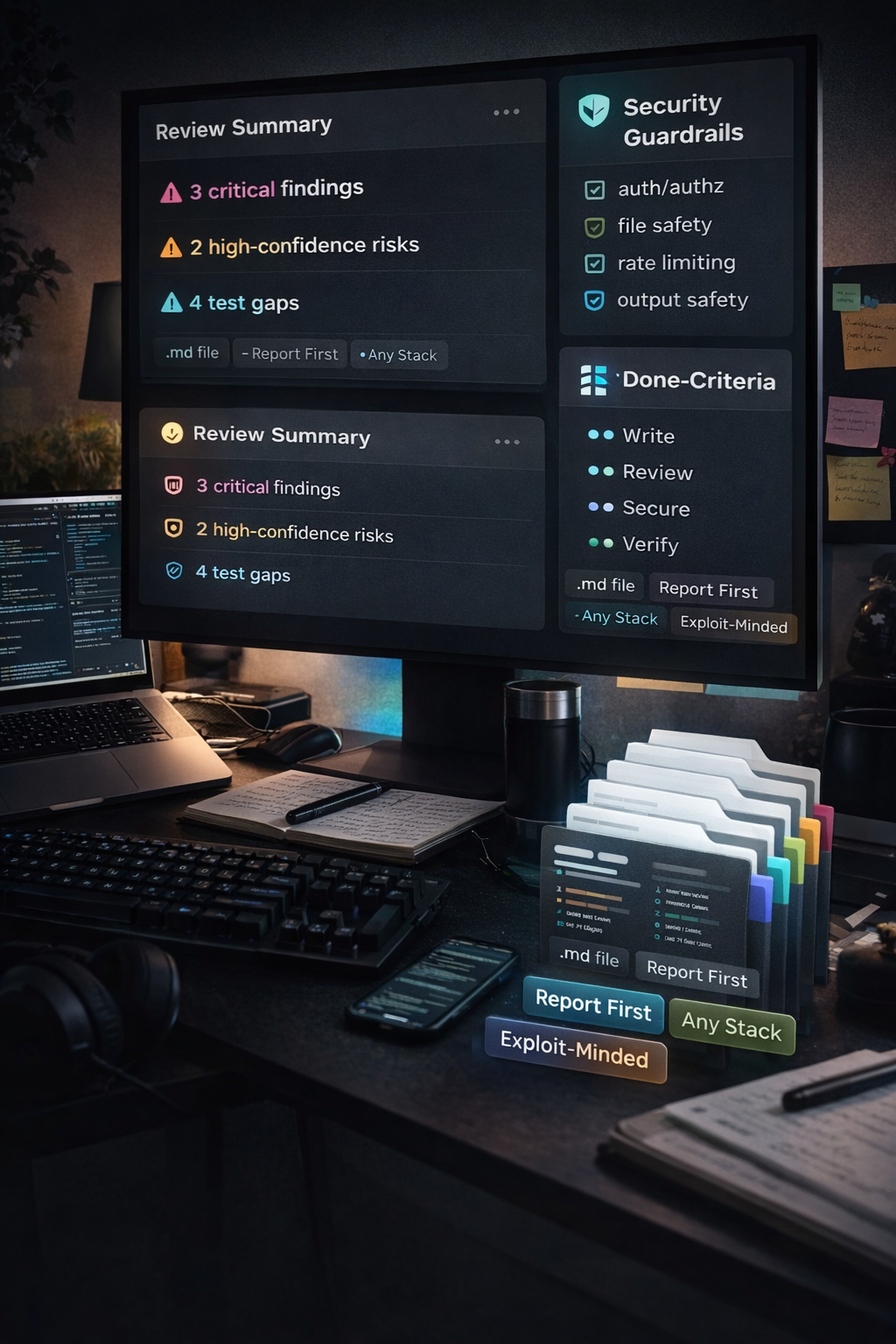
Use this before asking AI to build or change code. It makes the AI think more seriously about architecture, boundaries, failure paths, scale, maintainability, and long-term quality before it starts writing.
Use this before asking AI to inspect an existing codebase. It makes the AI review the whole relevant surface first, then produce a structured report about hidden bugs, structural risk, production pain, and remediation order.
Use this before asking AI to assess security. It makes the AI think more like a security engineer and attacker, covering access control, exploit paths, file risk, secrets, abuse, and production exposure.
Use this before asking AI whether a feature is really done. It makes the AI demand proof, identify blockers, classify missing evidence, and separate coded from truly verified and release-ready.
Use this before asking AI to inspect screens, forms, workflows, and visible product behavior. It forces deeper field-level validation thinking, negative scenarios, copy-paste weirdness, mobile friction, accessibility gaps, backend/frontend mismatch, and real user failure-path analysis.
The Core System
Each product is a single downloadable markdown (.md) constitution — structured instruction your AI reads before the real task. Together, the five files cover writing, review, security, manual QA, and done-criteria for serious software.
What these products actually are
Makes the AI think about architecture, correctness, scale, resilience, UX, and long-term maintainability before it writes code.
Makes the AI inspect the whole surface, classify risk properly, and produce report-first review output instead of patching blindly.
Makes the AI review code and product behavior with a much more exploit-minded security posture.
Makes the AI demand evidence, define blockers, and separate coded from truly verified and releasable.
Use this before asking AI to inspect forms, screens, workflows, and visible product behavior. It forces deeper field-level validation, negative scenarios, weird input, mobile friction, accessibility gaps, stale state, duplicate-submit risk, and backend/frontend mismatch checks.
If the answer is no, you already want what these constitutions do: sharper judgment, report-first reviews, and proof before anyone calls it done.
Use the full system together to write, review, secure, QA, and verify with much stronger discipline.
Underrated Advantage
A lot of embarrassing production issues are not deep backend bugs. They come from validation gaps, weird input, mobile friction, stale state, duplicate submits, accessibility misses, confusing feedback, and failure paths that polished demos hide. This file pushes the AI to inspect those much more seriously.
Document Previews (add real excerpt crops when ready)
Real excerpt from the file

Real excerpt from the file

Real excerpt from the file

Real excerpt from the file

Real excerpt from the file

Why the Bundle Wins
Most real products do not have one isolated weakness. They have mixed risk across writing, review, security, manual QA, and release confidence. That is why the full system is the smartest starting point for most buyers.
A single file is useful when your problem is narrow and obvious.
The bundle works better when the real problem is bigger than one isolated task.
A feature might need stronger writing, deeper review, better security thinking, manual QA, and real done-criteria at the same time. The bundle covers that reality much better than a single isolated file.
The bundle gives you a connected system for write + review + secure + QA + verify instead of fragmented prompting that changes quality every time.
The earlier the AI is guided properly, the less fragile code, hidden risk, manual QA pain, and expensive rework build up later.
Using one connected system makes the AI more consistent across feature work, audits, security checks, screenshots, validation review, and release decisions.
Beginners get stronger structure. Experienced users get less shallow AI noise, clearer workflows, and a better quality baseline across the full delivery process.
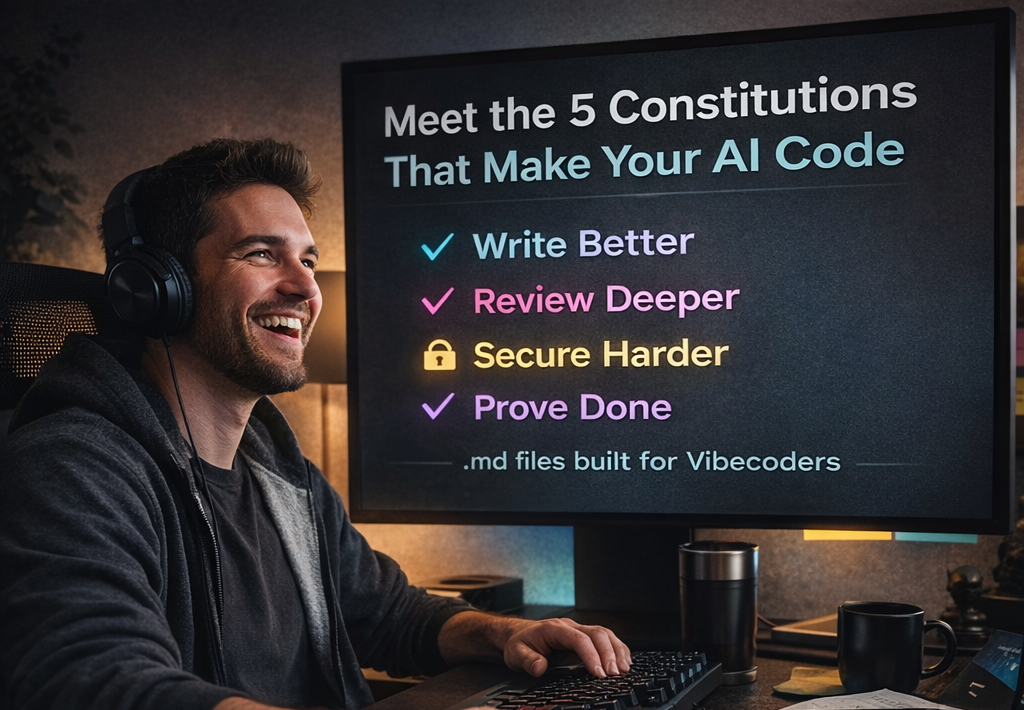
Best starting point for most buyers: the Full 5-File Bundle.
Want the strongest workflow? Start with the full system.
Jump to PricingSimple Workflow
You receive real .md constitutions. You show the right file to the AI first. Then you give the real task and use the output to decide what to do next.
Five steps to use your downloadable constitution .md files with your AI tool
| Step | What you do |
|---|---|
|
Receive the files
|
After purchase, you get downloadable .md constitution files. Save them somewhere easy to find. |
|
Pick the right file
|
Choose the file that matches your real goal: write, review, secure, manual QA-check, or verify release readiness. |
|
Show it to the AI first
|
Paste or attach that .md file in Claude, ChatGPT, Cursor, Windsurf, Codex, or a similar tool and tell the AI to read it first. |
|
Give the real task
|
Now ask the AI to build, review, audit, inspect screenshots/forms, or assess release readiness for your actual feature. |
|
Use the output properly
|
Review the report or result, fix what matters first, then run the next file if a deeper layer is needed. |
The files work best as a connected system when multiple risks are mixed together.
Proof, Not Hype
This is not about getting longer answers. It is about clearer reasoning, sharper priorities, and safer decisions before bad confidence becomes expensive. Each constitution is a real .md file the model reads first.
See why one stronger report can save weeks of bad confidence.
View PricingReal Vibecoding Scenarios
Most people do not lose time because AI writes nothing. They lose time because AI writes something that looks done before the dangerous parts are visible.
You told Claude or Codex to build a billing flow with retries, invoices, and customer-facing status.
The code works locally but misses idempotency, rollback thinking, partial-failure handling, and hidden state drift.
Universal AI Coding Constitution
The AI starts thinking about trust boundaries, retries, side effects, consistency, and release risk before it writes the first serious version.
You paste a large code file and ask the AI if everything looks good.
The AI gives shallow comments, misses structural weaknesses, and does not prioritize the biggest real risks.
AI Code Review / Bug Hunter Constitution
The AI first understands the system, then gives a report-first review with real risk categories, scenario analysis, and remediation order.
You ask the AI whether the code is safe enough to launch.
It misses exploit chains, weak auth assumptions, file handling exposure, callback risk, and abuse paths.
Security / OWASP Guardrails Constitution
The AI thinks more like an attacker and security reviewer, not just a helpful coding assistant.
The screen loads, the endpoint works, and the AI says it should be fine.
There is still no proof for wrong-user, wrong-tenant, failure-path, rollback, observability, or release readiness.
Testing & Done-Criteria Constitution
The AI separates implemented from verified and makes missing proof visible before release confidence becomes fake.
You created a form or workflow quickly with AI and it looks polished.
Validation stays shallow, copy-paste issues appear, mobile friction shows up, error handling is weak, and nobody checks the full manual scenario set.
Manual QA / Validation & Scenario Constitution
The AI produces a report-first manual QA view with field-level validation thinking, negative scenarios, usability checks, accessibility checks, and real workflow-based scenario planning.
Built For
CodeConstitutions is built for vibecoders, AI-first builders, and teams that want AI speed without blindly trusting the output.
Move fast with AI without letting your vibecoding workflow take reckless shortcuts.
Build lean with AI, but with stronger thinking around security, scale, and real-world behavior.
Add sharper guardrails to your vibecoding before code debt becomes production pain.
Push vibecoding harder while keeping engineering judgment stronger.
Use stronger systems when shipping client work that has to hold up.
Standardize how AI is used across writing, review, security, manual QA, and done criteria.
Not ideal for people who only want throwaway prototype code with no concern for quality, maintainability, or release confidence.

Why CodeConstitutions Feels Different
CodeConstitutions are structured markdown (.md) constitutions meant to be read by your AI before the real task — not one-line prompts you re-paste, and not apps, plugins, browser extensions, or SaaS dashboards.
AI already helps vibecoders move faster. CodeConstitutions helps them move faster without trusting the output too early.
Free Download
A sharp final-pass checklist to catch weak validation, shallow QA, missing edge cases, false done-criteria, and risky release confidence before you ship.
Use it as a fast final pass before release. Then use the full 5-file bundle when you want deeper writing, review, security, QA, and readiness systems.
Checklist request captured
Connect your email tool later to deliver the free download. This section is now ready for your real email automation.
Best Starting Point
Most Buyers Should Start With the Full 5-File Bundle.
Single files solve one isolated problem. The full system works better when writing, review, security, manual QA, and release readiness all overlap.
Fits Your Workflow
Choose the file you need, paste it into your preferred AI workflow, and then give the real task.
The Difference You Actually Feel
The value is not “more prompting.” The value is a stricter thinking system that changes how the AI writes, reviews, secures, QA-checks, and decides whether work is truly ready.
The goal is not to slow the AI down. The goal is to stop it from being careless.
Instant digital download · 5 markdown constitutions · works with Codex, Claude, Cursor, Windsurf, and similar AI tools
Choose Your Vibecoding System
Start with one downloadable .md for a specific vibecoding weakness, or get the full 5-file bundle for the complete write-review-secure-QA-verify workflow at the strongest per-file value.
Every purchase is a downloadable markdown file. Instant digital delivery. Ask the AI to read the relevant .md first, then give it the real task — works with Codex, Claude, Cursor, Windsurf, and similar tools.
Best for making AI write safer, cleaner, more scalable code before it starts.
Best for report-first review, hidden bug hunting, and production-risk discovery.
Best for exploit-minded AI security review across code, app behavior, and delivery risk.
Best for stronger verification, blocker logic, and evidence-driven done criteria.
Best for screenshot review, field validation, workflow scenarios, exploratory testing, and release-grade manual QA planning.
Get the full CodeConstitutions system for the complete write-review-secure-QA-verify workflow at the strongest per-file value.
Most vibecoders should start with the Full 5-File Bundle for the complete system and the strongest per-file value.
Questions Buyers Will Ask
Everything you need to know before choosing your CodeConstitutions system.
Both. CodeConstitutions ships as downloadable markdown (.md) files you point your tool at first — for Codex, Claude, Cursor, Windsurf, and other AI-assisted coding workflows.
Yes. The core bundle is designed to be stack-agnostic and useful across backend, frontend, full-stack, API, and product workflows.
No. They are structured constitutions designed to change how the AI thinks about writing, reviewing, securing, QA-checking, and verifying software.
Yes. You can start with a single constitution for a specific pain point or choose the full bundle for the strongest workflow.
No. It makes the AI much more disciplined, but it does not replace real engineering judgment, testing, profiling, security review, or product decisions.
Vibecoders, indie hackers, startup engineers, technical founders, agencies, and teams who want stronger AI-assisted software work.
Paste the right constitution into your AI tool first, then give the AI the real task. The constitution changes the quality bar the AI works under.
Yes. The CodeConstitutions 5-file system can expand into stack-specific and design-specific packs, but the current 5-file core bundle already forms the strongest starting system for serious vibecoding.
Because vibecoders often build UI quickly with AI and assume polished visuals mean the workflow is ready. The Manual QA / Validation & Scenario Constitution helps the AI inspect screenshots, forms, validation behavior, usability, accessibility, and real-world scenario coverage much more seriously.
Ready to upgrade how your AI thinks?
See Bundle PricingFinal Step
Give your AI a stricter operating system for writing, reviewing, securing, QA-checking, and verifying serious software — so “looks done” stops being good enough.